

To identify SANY reach stacker parts, record the machine and each assembly separately: full model and serial number from the machine plate; engine, transmission, drive axle and spreader from their own plates; and the assembly the part belongs to. The model name alone does not show what is fitted and can lead to the wrong part.
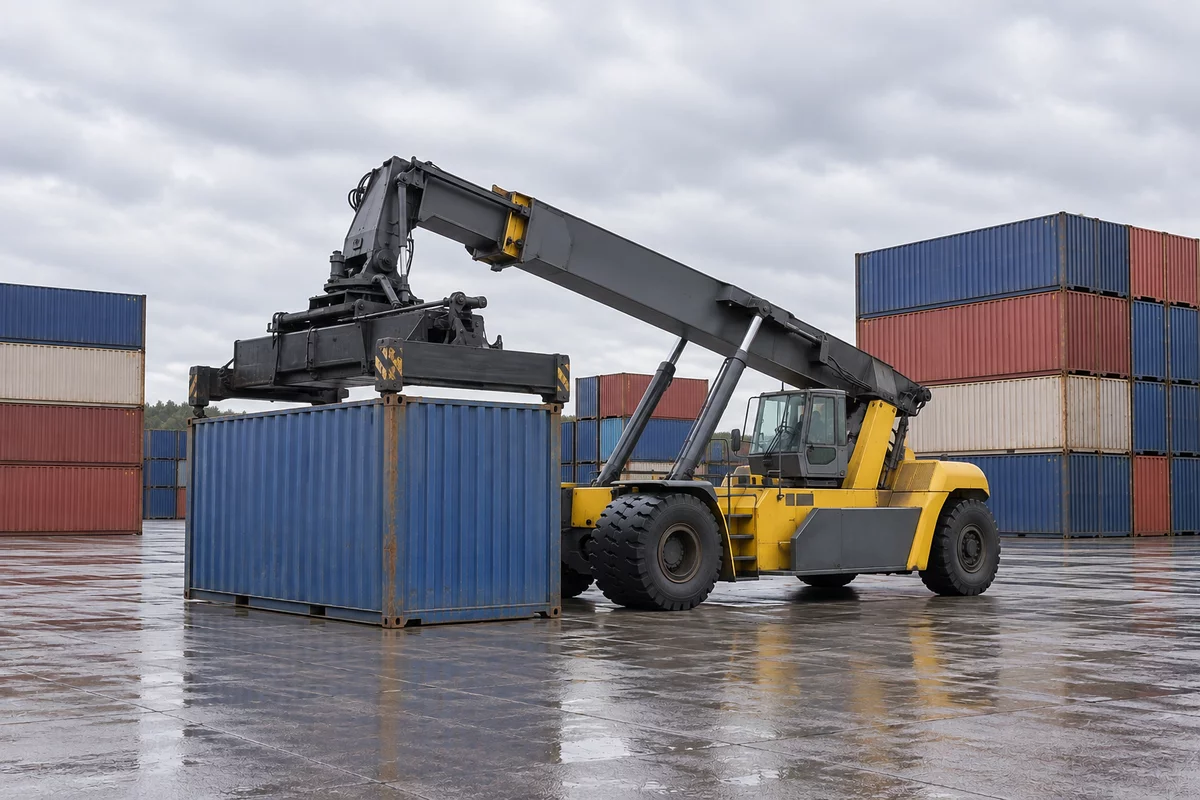
Illustration: a generic, unbranded reach stacker in a container yard. It does not show a specific SANY model.
A request that says only "SANY reach stacker, brake valve" leaves the supplier guessing which machine, which brake assembly and which revision you mean. This guide gives port and terminal fleets a worksheet for collecting that evidence before asking for a quote. It does not confirm compatibility, stock or price for any machine.
- Copy every identifier exactly. Mark unreadable characters as unreadable instead of filling them in.
- State the scope you need, complete assembly, sub-assembly or single part, before asking for a price.
- Send the worksheet with its photos so the evidence can be checked against your serial number.
Which identities does a reach-stacker parts request need?
A useful request carries six separate identities: the machine, the installed engine, the transmission, the drive axle, the spreader or attachment, and the part you want to replace. Each comes from its own plate, label or record. The machine serial number selects the right parts information; the assembly plates show what is actually fitted.
Swipe or scroll horizontally to view the full table.
| Record | Where the identity comes from | Why it is kept separate |
|---|---|---|
| Machine | Machine nameplate: full model with suffix, serial number, year if printed | Selects the model and serial range for every later lookup |
| Engine | Engine plate or label: maker, model or type, engine serial | One series name can cover more than one engine type |
| Transmission | Transmission plate: maker, model, transmission serial | Carries its own model designation in SANY's configuration tables |
| Drive axle | Axle plate, when the part belongs to the axle | Listed as its own row in the same tables |
| Spreader or attachment | Spreader plate, attachment records, replacement history | SANY names its spreaders separately from its machine models |
| Requested part | Old-part label, package label, parts-book page and callout | Shows which assembly and revision the part belongs to |
If the request involves only one assembly, keep the machine row anyway, because the serial range decides which parts information applies. Mark the other rows as not applicable and give the reason, for example "cab part, powertrain not involved". Port machines go through the same request flow as the other SANY machine lines we support; this guide covers the evidence, not a list of stocked models.
Takeaway: Keep one row per identity, even when several rows describe the same machine.
How should I record the machine model and serial number?
Copy the complete model designation exactly as it appears on the machine plate, including every suffix, then copy the serial number character by character. If a character cannot be read, write "unreadable" in its place. Do not complete it from another machine in the fleet or from a similar model.
SANY's own reach-stacker directory shows why the suffix matters. SRSC45H1, SRSC4535H1, SRSC45V, SRSC45V4 and SRSC4540G5-S appear there as separate entries, so a shortened name such as "SRSC45" points to several machines at once.
For the machine row, record:
- the model exactly as printed, with letters, digits and separators in order;
- the serial number from the plate, not from an invoice or a fleet list;
- the year of manufacture, if the plate shows one;
- your own fleet or asset number, labelled as yours so nobody mistakes it for a SANY identifier.
Photograph the whole plate straight on, then take a wider photo that shows where the plate sits on the machine. Give each photo one owner: a file named "machine-plate-01" should show only the machine plate. Our excavator nameplate guide shows how to transcribe model, suffix and serial fields; it describes an excavator plate and does not tell you where a reach-stacker plate is fitted. For the order of photos (location, whole part, label, interfaces, scale), follow how to photograph a part for identification.
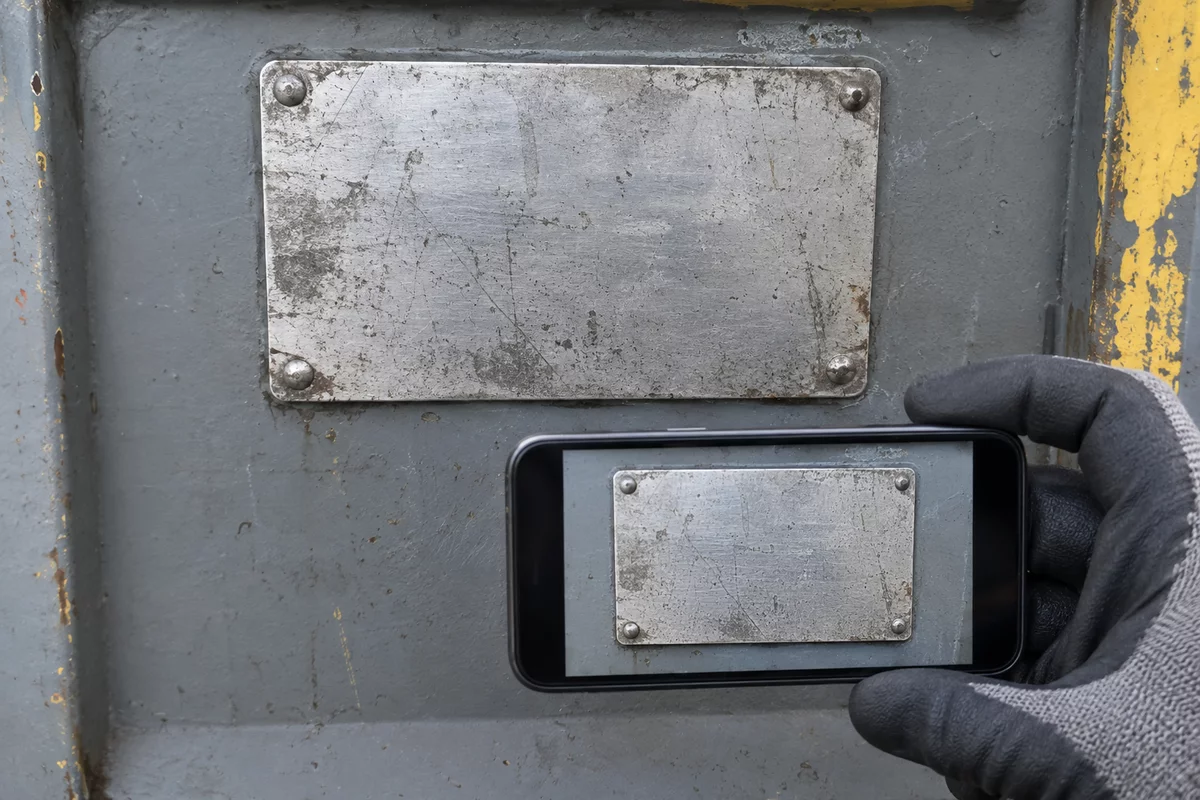
Illustration: photograph one plate per photo, straight on. Generic plate; real plate layouts and positions differ.
Common mistake: Copying the machine serial number into the engine or transmission row. Each assembly has its own serial number on its own plate. If you cannot read it, mark that cell unreadable.
Takeaway: The full model and the plate serial number start every lookup, so copy them exactly.
Why record the engine, transmission and drive axle separately?
The machine model does not tell you which engine, transmission or axle is installed. SANY's older reach-stacker brochure gives Engine, Gearbox, Drive Axle and Spreader their own rows in its configuration table, and under the "SRSC45H Series" heading it lists four engine types from Volvo and Cummins. Read the plate on the installed assembly instead of inferring it from the series name.
For each powertrain assembly involved in the request, record the maker, the model or type, the assembly's own serial number and any SANY part number on a label attached to it. A transmission request also needs the scope: the complete transmission, a sub-assembly of it, or a single part, together with the old part's number.
A package or old-part label can carry a SANY number, a component-maker number and a description. Record all of them rather than keeping the longest one. Then search each number in the part-number lookup exactly as you found it. A search with no result does not tell you whether the part can be sourced; it means the number still has to be checked by hand.
The brochure is an older document. It shows how SANY separated these assemblies when it was published and should not be used to decide what is fitted to your machine today.
Takeaway: Read the engine, transmission and axle identities from their own plates; the machine model only tells you where to start.
How do I identify the spreader or attachment?
Identify the spreader from its own plate and records, then link it to the machine serial number. SANY names its spreaders separately from its machines. The same older brochure lists container, empty-container, combined, tilt, log and tube spreaders, each with its own designation, and pairs the SRSC45H8 Series with an SDJ450H spreader and the SRSC45H Series with an SDJ450F.
For the spreader row, record:
- the spreader type in your own words, such as container spreader or empty-container spreader;
- the designation and serial number from the spreader plate;
- whether your records show the spreader was replaced or moved from another machine;
- the label on the old part, if the request is for a spreader component.
Calling a machine a "container handler" does not identify it either, because the category covers different builds. In the same brochure table, the SRSC1009-6E column pairs the SDJE100 empty-container spreader with a different engine, gearbox and drive axle from the SRSC45 columns. Use the plates, not the machine category.
You can browse published part identities in the parts catalog. A matching listing gives you something to check against; it does not confirm that the part fits your spreader.
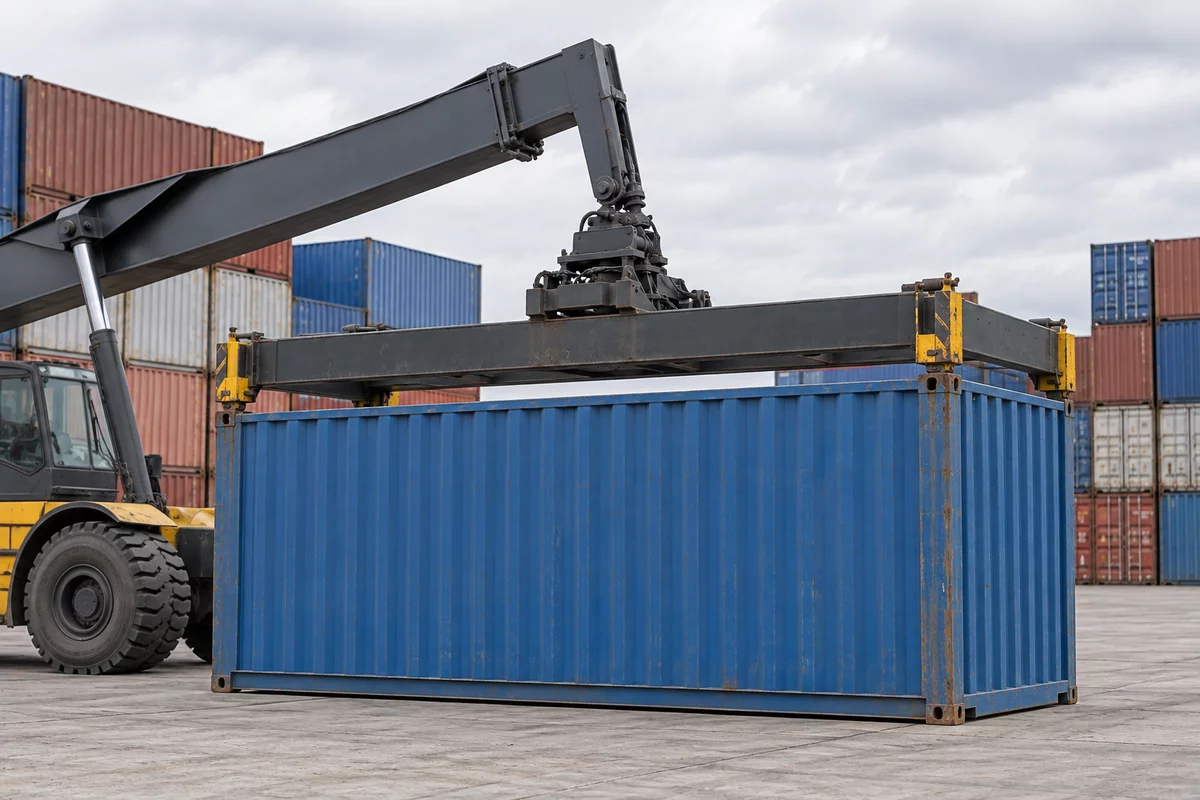
Illustration: a generic spreader under a boom head. It does not show where a plate is fitted; check your own spreader and its records.
Takeaway: Give the spreader its own row and tie it to the machine serial number.
Do you need the complete assembly, a sub-assembly or a single part?
Decide the scope and write it down before asking for a price. A word such as "brake" or "valve" can mean a complete valve group, one block within it, or a single valve or seal. Name the parent assembly, copy the parts-book callout if you have it, and state what the replacement must include and what it must not.
Published parts lists make the difference visible. One list for a single SANY reach-stacker model, for example, gives a brake valve group, a brake valve block and individual valves separate entries with separate numbers, and lists the valves inside a lift valve block one by one. A request for "the brake valve" could match any of those levels.
Record the scope with these fields:
- parent assembly name and number, as shown on the label or parts book;
- diagram title and the item callout, if you have the parts book;
- requested scope: complete assembly, sub-assembly, single part or kit;
- what must be included, such as seals or fittings, and what must not;
- quantity.
Seal kits follow the same rule. Our seal kit category identifies kits by the old kit number and the component dimensions rather than the machine name alone. If you will accept a specified-quality or replacement part, say so in the request; the genuine parts guide explains how the supply types differ.
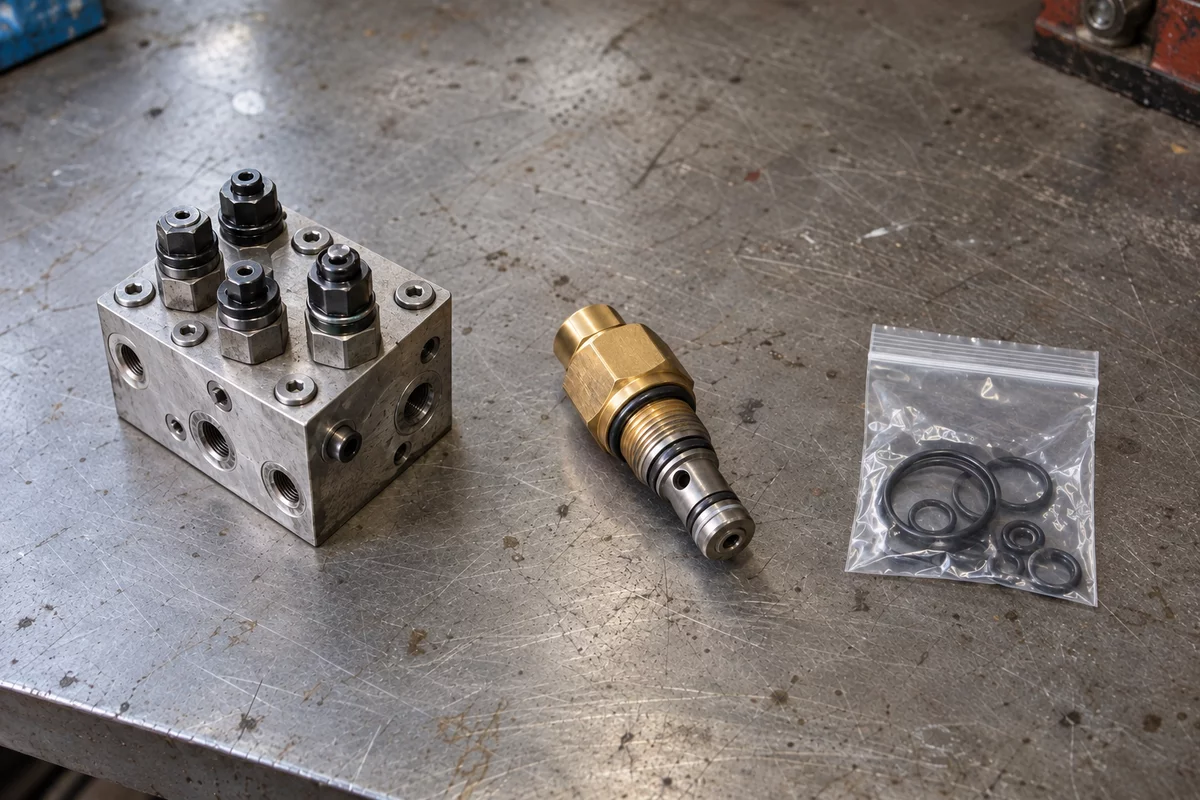
Illustration: three unrelated generic items for three request scopes: an assembly, an individual part and a seal kit. They are not a matched set.
Common mistake: Asking for "SANY brakes" or "transmission parts" without the parent assembly. The reply will be a question, not a quote.
Takeaway: State the parent assembly and the scope before anyone looks for a price.
Reach-stacker parts evidence worksheet
Copy this table into a spreadsheet or message and fill one row per identity. Use a status word instead of leaving a cell blank, so the person checking can tell a missing photo from a field that does not exist.
Swipe or scroll horizontally to view the full table.
| Record | Copy exactly | Photos and documents | Leave open until confirmed |
|---|---|---|---|
| Machine | Full model with suffix; serial number; year if printed; your fleet number, marked as yours | Whole plate straight on; plate location on the machine | Unreadable characters, by position |
| Engine | Maker; model or type; engine serial; any SANY number on its label | Engine plate; old-part label | Plate fields you cannot read |
| Transmission | Maker; model; transmission serial; old-part number | Transmission plate; old part in place and removed | Whether a sub-assembly or the complete unit is needed |
| Drive axle | Maker; model; axle serial, when the part belongs to the axle | Axle plate; old part | Position, if the part is fitted in more than one place |
| Spreader or attachment | Type in your words; designation; spreader serial; replacement history | Spreader plate; whole spreader on the machine | Whether the spreader was changed after delivery |
| Requested part | Every number on the part and its package; description; parent assembly; scope; quantity | Label; interfaces beside a ruler; package label; parts-book page with the callout marked | Superseded or alternative numbers |
Use four status words. Write "unknown" when you have no information for a field, and "unreadable" when the plate or label exists but some characters cannot be read (say which ones). "Not supplied" means you have the information but have not sent it yet. "Not applicable" means the field does not exist for this request, and needs a short reason.
This worksheet is our own way of organizing the evidence. It is not a SANY form or an industry standard.
Takeaway: A completed row with honest status words is more useful than a full row with guessed values.
When this worksheet does not apply
The worksheet organizes evidence. It cannot settle questions that depend on a check of that evidence or on work at the machine.
- It does not confirm that a part fits, is available or has a particular price. Those depend on a check of your evidence and a written quote.
- It does not tell you where plates are fitted on your machine, how to remove components or how to diagnose a fault. Follow the documentation for your machine and use qualified staff for work on hydraulic, braking or lifting systems.
- The brochure details quoted here come from an older document. They show how SANY separated assemblies at that time, not what is fitted to a machine in service today.
- A third-party parts list shows how one supplier divides assemblies. It does not approve a part for your serial range.
- For warranty work or an official parts book, contact SANY or the dealer responsible for your market. SANY Parts is an independent supplier, not SANY Group or an authorized dealer.
Takeaway: Use the worksheet to prepare the request; confirmation comes from the check that follows it.
What to send us
Send the completed worksheet with the photos it refers to. We check the evidence against the machine model and serial number before quoting, and the quote states the supply type we can deliver. If something is missing, we ask for it.
Swipe or scroll horizontally to view the full table.
| Item | Why we need it | Example format |
|---|---|---|
| Machine plate photo, model and serial | Selects the serial range for the lookup | Plate photo plus the model and serial typed as printed |
Engine, transmission, axle or spreader plate, as relevant | Confirms what is installed | One photo per plate, named after its row |
| Old-part and package labels | Gives every number, including component-maker numbers | Straight-on photos; numbers typed exactly as written |
| Parent assembly and scope | Separates a complete assembly from a sub-assembly, part or kit | "Brake valve block, complete" or "single valve only" |
| Parts-book page or diagram, if available | Shows the revision and position | Page photo with the item callout marked |
| Quantity and destination port | Needed before a quote can be written | Number of pieces and the port name |
Already have a number? Search it in the part-number lookup and include the result link, or the exact query if nothing matched.
Takeaway: Send the worksheet and its photos together, so each photo can be matched to its row.
Common questions about SANY reach-stacker parts
Where can I get a parts manual for my SANY reach stacker?
Parts books are tied to the machine's serial range, so ask SANY or the dealer responsible for your market for the book that matches your serial number. We do not host SANY parts books. A photo of the relevant page, with the item callout marked, is still useful evidence in a request.
How do I use a parts diagram to identify the part I need?
Record the diagram title, any revision or date printed on the page, the parent assembly and the item callout number. The diagram shows where the part sits and what it belongs to. The old part's label and your serial range still need to agree with it.
Does a matching catalog listing confirm that a part fits my machine?
No. A listing with the same name or number shows a published identity. Fit depends on your machine's serial range, the installed assembly and the old part's revision, and those have to be checked together.
Can a parts list for an SRSC45V identify a part for another reach stacker?
Not on its own. SANY's directory lists SRSC45V, SRSC45V1A, SRSC45V3, SRSC45V4 and SRSC45V5 as separate models. Treat another model's list as a lead, then check it against your own plates and old-part labels.
Is "container handler" enough to identify the part I need?
No. It names a type of machine, not a model. Send the full model and serial number from the machine plate and the spreader's own identity, because the machine and the spreader are identified separately.
Does a reach-stacker parts manual also cover the engine, transmission and spreader?
Do not assume it does. Ask whoever supplies the book which assemblies it covers for your serial number, and check its contents for engine, transmission, drive axle and spreader sections. Identify any assembly the book does not cover from its own plate and records, as in the worksheet above.
Sources and method
- SANY reach stacker product directory, checked 11 October 2026, for the list of separately named models.
- SANY reach stacker brochure, an older document whose file URL carries a 2017 date. We used its configuration table (PDF page 11) for the separate engine, gearbox, drive axle and spreader rows, and its attachment options (PDF page 8) for spreader designations. It is historical context, not a description of current machines.
- A third-party parts list for one SANY reach-stacker model, reviewed only for how it divides assemblies. It is not used as a fitment source.
- Our about page and part-number guide for our request process and number-recording rules.
This guide was compiled from public sources and our published request process. No machine was inspected for it. Updated 11 October 2026.
Related reading:
- How to find a SANY part number: record every number on the old part and its package.
- How to photograph a part for identification: the photo order for labels, interfaces and scale.
- All news and technical articles: more parts identification guides.
Last reviewed: Oct 11, 2026