

Choosing between excavator rubber vs steel tracks from a generic jobsite pros-and-cons list alone can leave you ordering a track assembly that fails to fit your machine's sprockets, rollers, or track adjuster. Confirm what undercarriage configuration is currently fitted on your SANY excavator and what the serial-specific parts record allows before comparing rubber belts, steel chains, and rubber pads against ground conditions.
When buyers evaluate a rubber track vs steel track excavator setup—or weigh excavator metal tracks vs rubber at replacement time—two hardware boundaries come before terrain preference. First, continuous rubber belts and linked steel chains do not automatically share the same roller flanges, idlers, or tensioner hardware across every model and serial range. Second, adding surface protection to a steel-tracked machine with bolt-on, clip-on, or chain-on rubber pads is a different parts request from converting the undercarriage to a one-piece rubber track.
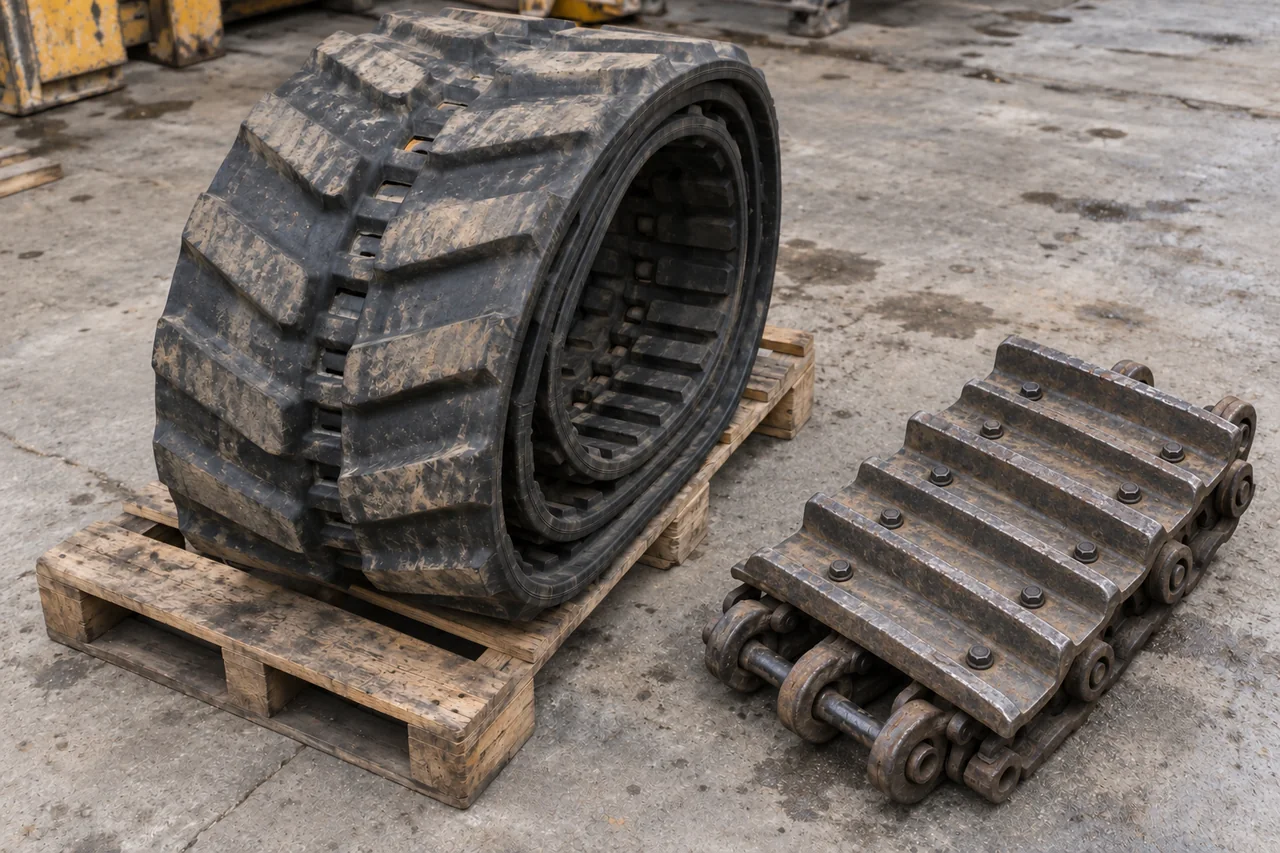
A continuous moulded rubber belt and a linked steel track with bolted grouser shoes are distinct assemblies.
This guide provides a compatibility-first routing table, a jobsite comparison matrix, and a blank unit-verification record to complete before requesting a quote. It does not repeat the chain-stretch and roller wear measurements covered in our excavator undercarriage wear and replacement guide, and it does not promise that any SANY model can convert between rubber and steel without serial-specific verification. The photographs show typical undercarriage components for illustration; use photos of your own machine for the actual match.
Swipe or scroll horizontally to view the full table.
Option under consideration | How the assembly is built | What must be confirmed on your SANY unit first |
|---|---|---|
| Continuous belted rubber track | One-piece vulcanized rubber belt with internal cords and embedded metal drive cores; no separate shoes or chain links | Serial-specific parts eligibility, moulded belt size code (width, pitch, link count), and matching rubber-track roller/idler profile |
Linked steel track (bare steel shoes) | Pinned steel track chain with individual bolted steel grouser shoes | Approved steel-track option for the serial, chain pitch and link count, shoe width, and compatible roller flange / adjuster setup |
Bolt-on rubber pads on steel shoes | Rubber pad with threaded studs or bolts that pass through pre-drilled holes in the existing steel track shoe | Existing steel track shoes must have matching bolt holes, shoe width, and grouser profile |
Clip-on rubber pads on steel shoes | Rubber pad slid sideways over the steel shoe plate and clamped with side brackets (clips) | Exact steel shoe width, edge thickness, and clearance so the side clips seat without striking the track frame |
Chain-on rubber pads on steel links | Rubber pad vulcanized to a steel core plate that bolts directly onto the bare steel track chain in place of the steel shoe | Steel shoes removed; chain link pitch, bolt-hole spacing, and bolt diameter on the existing steel chain must match |
Start with the fitted undercarriage, not the terrain list
Before comparing turf protection against rock durability, check whether your excavator is simply due for a like-for-like replacement or whether you are asking to change the track type. As TVH notes in its December 2023 undercarriage guide, there is no universal international measurement standard across excavator tracks, and each manufacturer configures its own undercarriage system.
In SANY America's published specifications (retrieved October 2026) and this site's excavator model index, standard factory setups follow machine class: mini and compact models such as the SY35U (standard 300 mm / 12 in belted rubber track with 4 track rollers and 1 carrier roller per side) and the SY60C (standard 400 mm / 16 in belted rubber track with 5 track rollers and 1 carrier roller per side) list belted rubber tracks as standard, while medium and large crawlers such as the SY135C, SY155U, SY215C, and SY365C list steel tracks.
Treat those brochure figures as class baselines only. They do not confirm how a specific serial-numbered machine was ordered, whether a factory steel or rubber option exists for your unit, or which components must change during a swap. As Fortis HD's August 2024 comparison of compact equipment undercarriages explains, switching a machine between rubber and steel tracks is straightforward on some designs but requires changing single-flange rollers to dual-flange rollers, replacing idlers or carrier rollers, or fitting a different track adjuster on others. Never assume a rubber belt and a steel chain interchange on the same rollers without checking the serial-specific parts book. Start by recording the full model and serial from the machine plate using our SANY excavator nameplate guide.
Separate a continuous rubber track from steel-track rubber pads
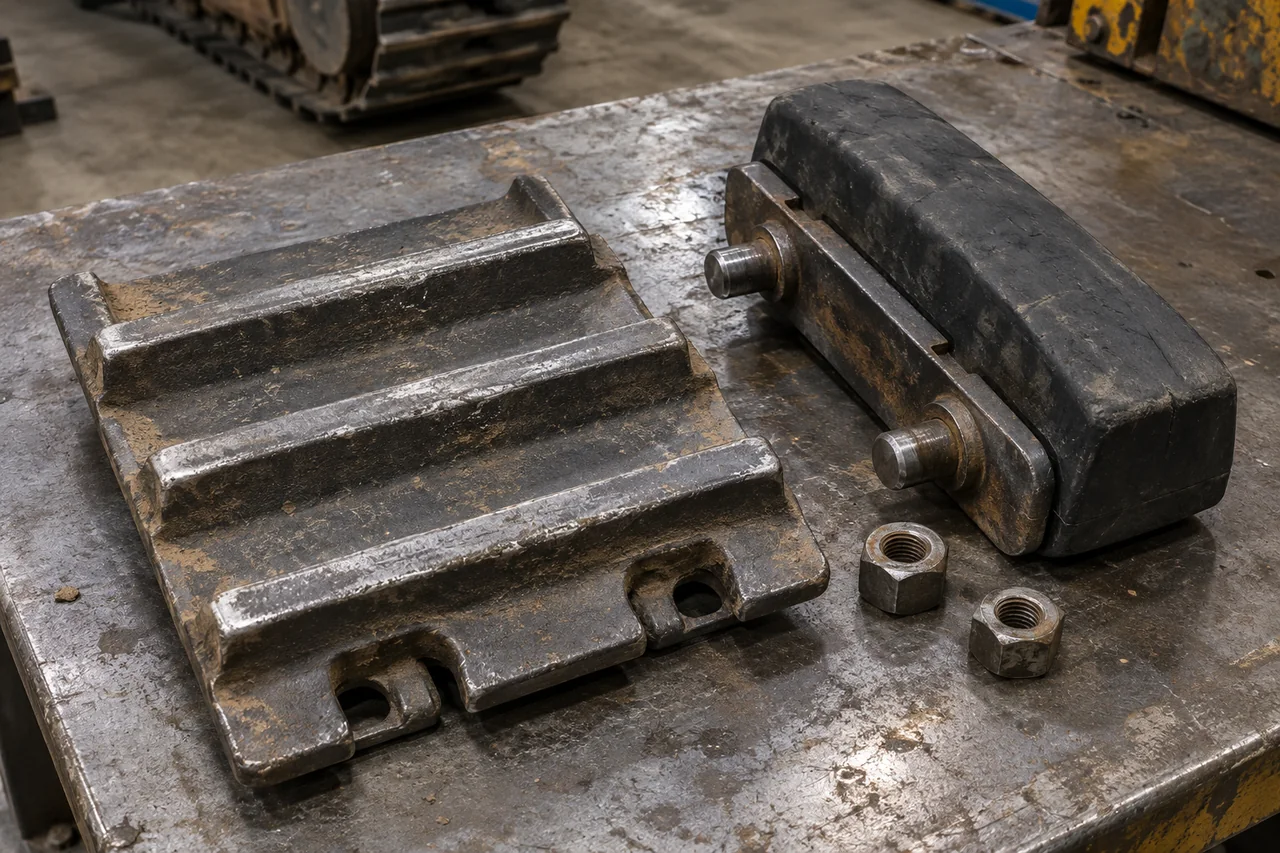
A steel triple-grouser track shoe and a bolt-on rubber pad with mounting hardware on a workbench.
Many requests for "rubber tracks" on a steel-tracked excavator are actually requests for rubber pads—and the reverse is impossible. Rubber pads are protective shoe covers or shoe replacements designed exclusively for a linked steel undercarriage; they cannot be bolted or clipped onto a continuous rubber belt.
If your excavator already runs a steel link chain and needs temporary or long-term pavement protection, TVH's technical guide distinguishes three rubber pad mounting styles:
- Bolt-on pads mount directly onto the steel track shoe through bolt holes in the plate. They are a practical option when the existing steel shoes are already pre-drilled for pads and remain structurally sound.
- Clip-on pads slide sideways onto the steel track plates and lock in place with side brackets (clips). Because they clamp around the outer edges of the steel shoe rather than bolting through the plate face, every clip-on order depends on matching the exact shoe width and profile.
- Chain-on pads require unbolting and removing the steel grouser plates so the rubber-covered pad assembly bolts directly to the steel track links. TVH notes that because the rubber surrounds the steel backing part, chain-on pads reduce the risk of exposed steel edges marking finished pavement, making them suited to steel-chain machines that work mainly on hard surfaces.
Keep this boundary clear on your purchase request: ordering a continuous rubber belt for a machine built only for steel chains—or ordering bolt-on pads for undrilled steel shoes—stops installation before the machine leaves the bay.
Compare jobsite surface protection against sharp debris and traction
Once you know which configurations your undercarriage supports, weigh the operating environment. Published guidance from TVH (December 2023), Prime Source, Vematrack (updated June 2024), OEM track descriptions, and operator reports on Heavy Equipment Forums highlights a consistent trade-off between surface preservation and resistance to sharp, abrasive ground.
Swipe or scroll horizontally to view the full table.
| Jobsite factor | Continuous rubber track | Linked steel track (bare steel shoes) | Steel track with rubber pads | Decision check for the buyer |
|---|---|---|---|---|
Finished asphalt, concrete, curbs, and turf | Protects delicate surfaces and leaves minimal marks during normal travel (deep lugs can still indent soft turf on sharp turns) | Steel grousers scar pavement, crack curb edges, and tear up finished landscaping | Cushions steel shoes for crossing or working on paved surfaces; chain-on pads cover more of the steel shoe than clip-on brackets | Specify whether pavement work is full-time or occasional crossing |
Demolition debris, rebar, jagged rock, and stumps | High risk of tread chunking, sidewall cuts, and severed internal cords | Withstands sharp rock and abrasive debris with minimal puncture or tearing risk | Rubber pad faces still tear or chunk if driven over sharp rebar or blasted rock; pads can be removed when returning to rough dirt | Avoid rubber belts and remove temporary pads where sharp debris dominates |
Wet mud, loose slopes, and machine stability | Flexible belt conforms and slips more easily on slick mud or steep, uneven grades | Rigid overlapping shoes and heavier mass lower the center of gravity and bite into mud, clay, and slopes | Retains steel-chain weight and rigidity, though flat rubber pad faces have less bite in slick mud than bare grouser bars | Check slope, mud depth, and whether steel shoe width options apply |
Oil, grease, chemicals, and packed sand | Rubber compounds degrade if exposed to oil, grease, or harsh chemicals; packed sand in the guide rail can cause de-tracking if not cleaned | Steel resists chemical degradation and sheds loose rock more readily, though mud packing still requires tension checks | Rubber pad material shares chemical sensitivity and requires checking fastener torque and trapped debris | Record chemical exposure and daily track-cleaning discipline on site |
Operator vibration and urban noise | Quieter travel and lower high-frequency vibration on hard ground | Louder metal clanking and harsher vibration transmitted to the cab on hard ground | Dampens hard-surface contact noise and vibration compared with bare steel grousers | Check municipal or residential noise restrictions before selecting bare steel |
| Service and failure boundary | No pin-and-bushing joints to service, but if the continuous belt breaks, the entire track is scrapped | Requires periodic link-pitch, bushing, roller, and tension checks, but individual damaged links or shoes can be replaced | Individual torn pads can be unbolted or unclipped without replacing the steel chain | Weigh whole-belt replacement risk against modular shoe/pad maintenance |
Takeaway: If a compact SANY excavator works on asphalt, driveways, or finished landscaping and already runs a belted rubber undercarriage, stay with the serial-matched rubber track; if the machine works in demolition, sharp rock, or heavy forestry and is approved for steel, bare steel shoes avoid premature belt failure while removable rubber pads handle occasional paved crossings.
Inspect the fitted rollers, sprocket, and old markings before ordering
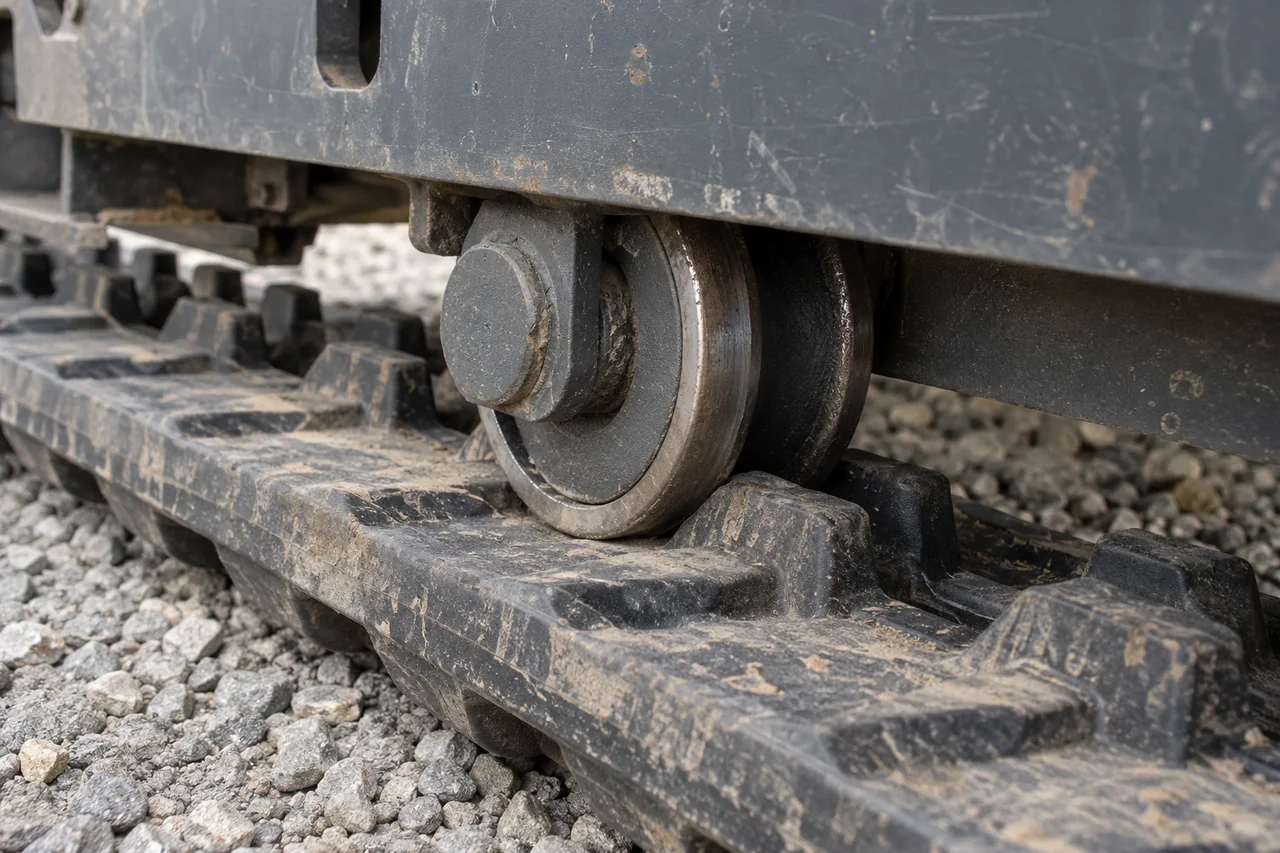
Bottom roller flange geometry and inner track guide lugs must match the installed track type.
Before sending an inquiry, gather physical evidence from the machine while it is parked on level ground with the attachment lowered. Do not loosen grease track tensioners or disassemble recoil springs to take identification photos—the recoil cylinder and spring are under high load.
Capture four pieces of visual evidence:
- Machine nameplate: Photograph the full machine nameplate and transcribe the complete model and serial number. Production breaks can change roller, idler, and sprocket part numbers within the same model family.
- Existing track markings: On a rubber track, check the inside surface of the belt for a vulcanized or stamped size and part code. On a steel track, check the chain links for a forged link number and record the shoe width and bolt pattern. If a number is partially worn, follow our guide on how to find a SANY part number.
- Roller and sprocket engagement: Take a clear close-up showing how the bottom rollers, carrier roller, front idler, and drive sprocket teeth sit against the track's inner guide lugs or chain links. Use the steps in our part-photography guide so both wide location shots and close-up markings stay paired.
- Companion undercarriage condition: If the machine is already on steel tracks, check whether the sprockets, rollers, and chain bushings are worn before bolting new shoes or pads onto a stretched chain. See the excavator undercarriage wear guide for the tape-measure and straight-edge checks, and browse the SANY undercarriage parts hub to review the related component groups.
Keep one compatibility and jobsite record for the request
Copy this verification table into your maintenance notes before asking for a quote. Fill the middle column from your own machine and jobsite; write “Unknown / verify on the unit” wherever a marking is unreadable or a manual page is unavailable. Do not copy track dimensions from a generic aftermarket chart.
Swipe or scroll horizontally to view the full table.
| Field | Your unit or jobsite record | Evidence to attach |
|---|---|---|
| Full machine model and suffix | Whole machine nameplate photo | |
Machine serial / production number | Uncropped nameplate close-up plus text transcription | |
Currently fitted assembly on the machine | Side photo showing continuous rubber belt, bare steel shoes, or steel shoes with pads | |
Old-track moulded code or stamped link number | Close-up photo of inner belt marking or steel link casting code | |
Measured track or shoe width and bolt-hole layout | Straight-on tape photo across the shoe or belt (and pad bolt holes if fitted) | |
Bottom roller flange and sprocket arrangement | Close-up of roller flange profile and sprocket engagement on the current track | |
Requested change (like-for-like, pad addition, or conversion check) | Written note stating whether you want the same setup, rubber pads on steel, or a serial check for another track type | |
Primary ground surface and sharp-debris risk | Short note on paved surfaces, mud/slopes, demolition debris, or chemical exposure |
What to send us
Start with the machine model, serial number, and photos of the currently fitted track and undercarriage. Include any readable belt or link markings and state whether you are replacing the current setup like-for-like, adding rubber pads to existing steel shoes, or checking whether an alternate track configuration is listed for your serial.
Swipe or scroll horizontally to view the full table.
| Item | Why we need it | Example format |
|---|---|---|
| Full model and serial | Verify the factory undercarriage configuration and serial-specific parts list | Nameplate photo plus exact transcription |
| Current track and roller photos | Distinguish a continuous rubber belt from steel shoes and check roller flange geometry | Side view of the undercarriage plus a close-up of one roller and shoe |
| Old-part markings or shoe width | Cross-check the fitted belt code, link casting number, or steel shoe pad interface | Photo of inner belt code, link stamp, or tape across the shoe; or “no readable marking” |
Target setup and jobsite conditions | Clarify whether the quotation should cover a rubber belt, steel chain/shoes, or bolt-on / clip-on / chain-on pads | “Same as fitted,” “bolt-on pads for steel shoes,” or “check if steel option exists for this serial” |
Send that evidence set through the button below for a parts inquiry. As described on our about page, we check compatibility against the machine serial number and state the supply category in the quotation. Whether a given serial number supports converting between rubber and steel—and which rollers, idlers, or pads are required—must be confirmed against the machine's parts record before ordering.
Method and sources
Updated October 2026. SANY class baseline examples come from SANY America's published product specifications for the SY35U and SY60C (retrieved 17 October 2026) and the model specifications compiled in this site's catalog. General operating trade-offs between continuous rubber tracks, linked steel tracks, and bolt-on, clip-on, and chain-on rubber pads are compiled from TVH's Rubber versus steel tracks, which one to pick? (published 13 December 2023, retrieved 17 October 2026), Prime Source's Deciding Between Steel or Rubber Tracks (retrieved 17 October 2026), Vematrack's Mini excavator with rubber tracks vs. steel tracks (updated 14 June 2024, retrieved 17 October 2026), Fortis HD's 5 Factors to Help you Decide Between Steel and Rubber Tracks (updated 15 August 2024, retrieved 17 October 2026), operator discussions on Heavy Equipment Forums (Rubber or Steel Tracks?, thread started 12 April 2009), and general OEM excavator track descriptions. Those external sources describe general track materials and non-SANY equipment examples; they do not establish SANY model interchangeability, warranty coverage, service life, or track dimensions. SANY Parts is an independent supplier; official factory conversion approvals and manuals should be obtained through SANY or an authorized dealer for the machine's market.
Last reviewed: Oct 17, 2026